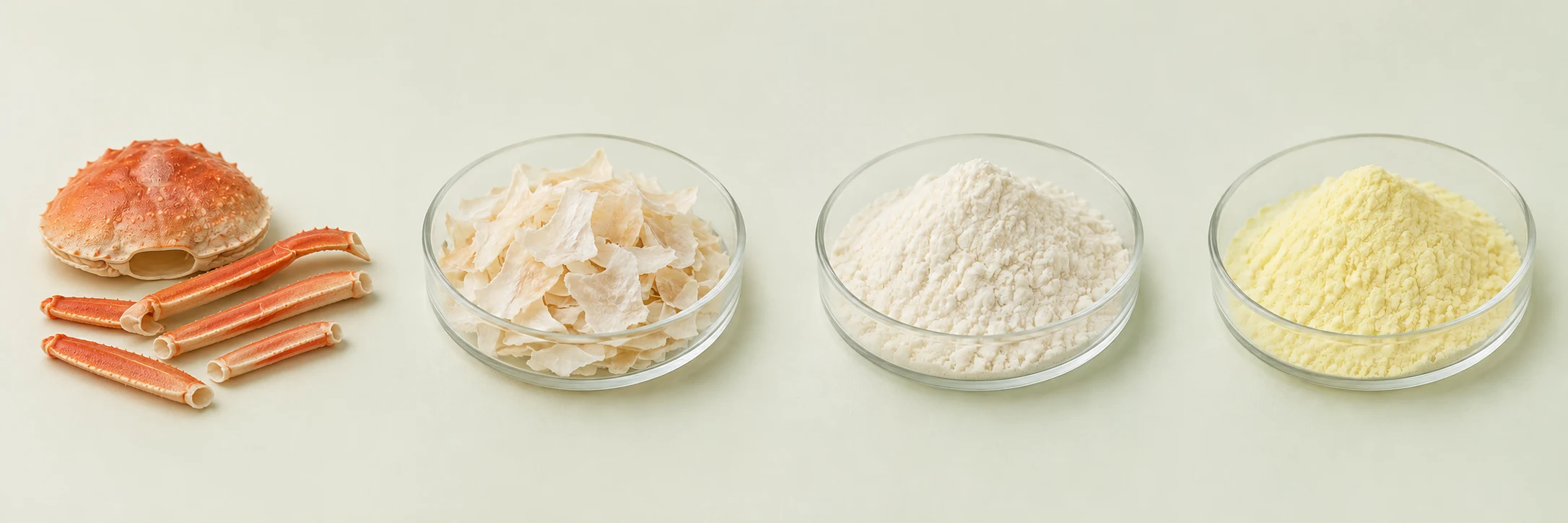
Snow crab shells
An illustrative crustacean source; confirm the actual raw material for the selected grade.

Compare the materials, explore a common preparation pathway and choose the technical file for your application.
| Material | Identity and chain size | Water and formulation behavior |
|---|---|---|
| Chitin | A natural polysaccharide. Chain size varies with source and processing. | Generally insoluble in water. |
| Chitosan | Obtained by deacetylating chitin; molecular weight and degree of deacetylation vary. | Conventional grades are poorly soluble in neutral water; suitable dilute acids improve dissolution. Modified grades differ. |
| Chitosan oligosaccharide (COS) | Shorter-chain fragments. Confirm assay, average molecular weight and distribution. | Typically more water-soluble than conventional chitosan; composition, pH and grade still matter. |
A ≤3,000 Da limit describes a selected grade, not every COS material. Absorption and biological response cannot be assigned one percentage across all products, species and uses.
An illustrative crustacean source; confirm the actual raw material for the selected grade.
Extraction removes proteins and mineral components.
Deacetylation removes acetyl groups from chitin.
Chemical or enzymatic hydrolysis produces shorter-chain material.
Illustrative images; appearance varies by source, grade and process.
This is an illustrative route. Membrane operations, sampling points and drying depend on the selected process. It does not establish a cleanroom classification or validated manufacturing claim.
Technical background: Production of Low Molecular Weight Chitosan and Chitooligosaccharides (COS): A Review (2021); Bioproduction of Chitooligosaccharides: Present and Perspectives (2014).